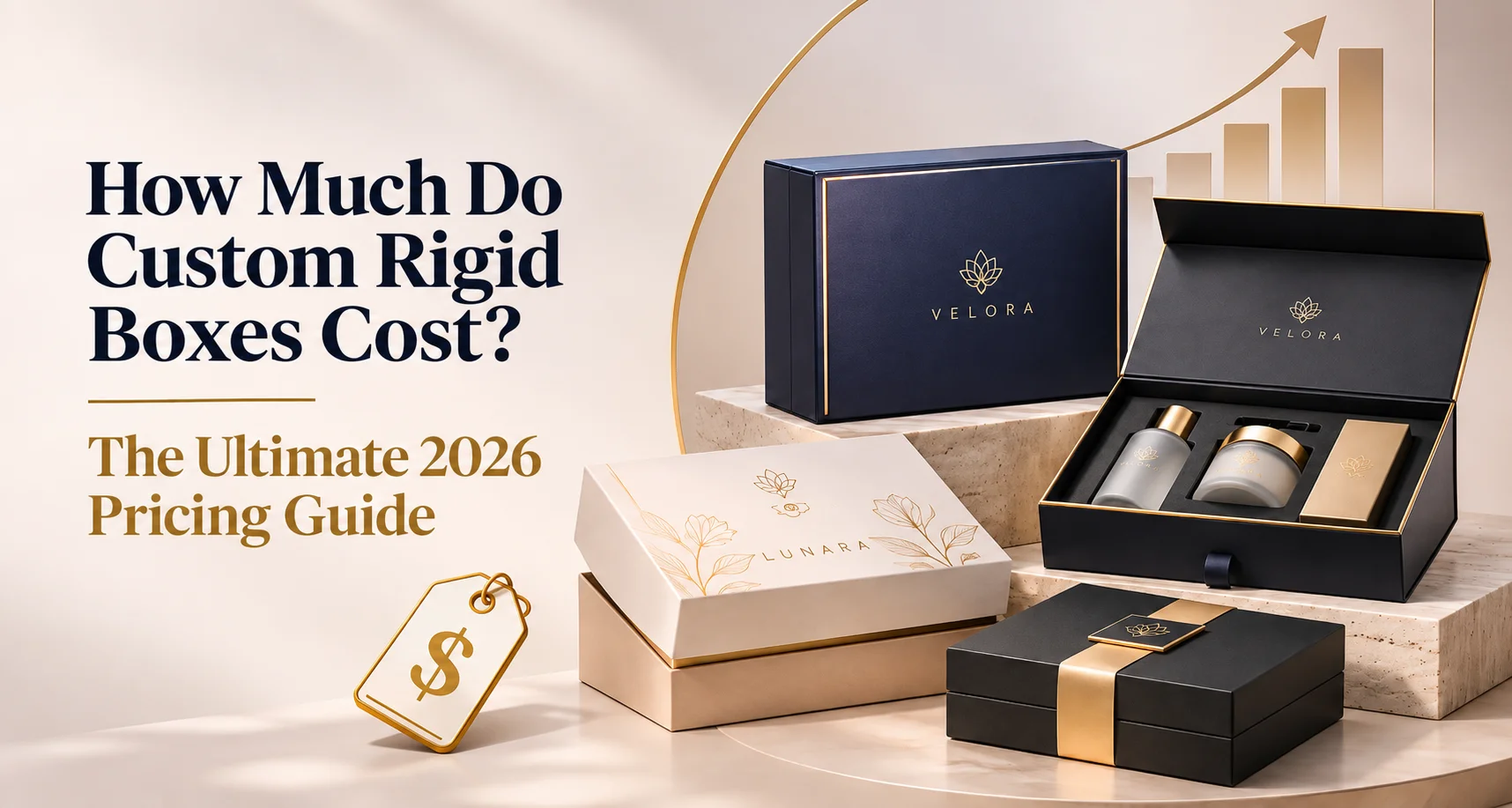
When launching a luxury product, a high-end subscription kit, or creating an unforgettable unboxing experience, custom rigid boxes are the premium option. Whether you are packaging jewelry, electronics, or corporate gift items, rigid boxes elevate your brand's value immediately.
However, when brand founders start asking for packaging quotes, the pricing can seem confusing. Depending on your specs, quotes can range anywhere from $0.49 per box for large-volume order runs to $15.00+ for custom builds. Why is there such a broad price range? What factors drive up the cost of rigid boxes? And how can you optimize your packaging design to fit your exact budget?
In this comprehensive pricing guide created by The Rigid Boxes, we break down every single pricing detail based on industry standards and real-world manufacturing metrics.
How Much Do Custom Rigid Boxes Cost?
To give you an immediate benchmark before diving into the structural details, rigid box pricing is determined by order volume and box architecture. Unlike standard boxes that ship flat, rigid boxes are built around heavy-duty greyboard cores that maintain their shape. This structure requires specialized machinery, skilled assembly, and higher freight volume.
| Order Quantity Tier | Price Range Per Unit | Estimated Total Investment | Best For |
|---|---|---|---|
| Low Volume (100 – 500 units) |
$2.80 – $9.50+ | $725 – $1,700+ | Product testing, seasonal kits, limited launches |
| Mid Volume (1,000–2,500 units) | $1.65 – $4.50 | $1,520 – $3,875 | Scaling e-commerce brands & established retail |
| High Volume (5,000 – 10,000+ units) | $0.49 – $1.30 | $3,500 – $6,500+ | Large-scale retail & global distribution |
Key Takeaway: As your order quantity scales, fixed machinery setup fees and custom die making costs get divided across more units. This drastically lowers your individual cost per unit.
Rigid Boxes vs. Other Packaging Types: Cost & Value Comparison
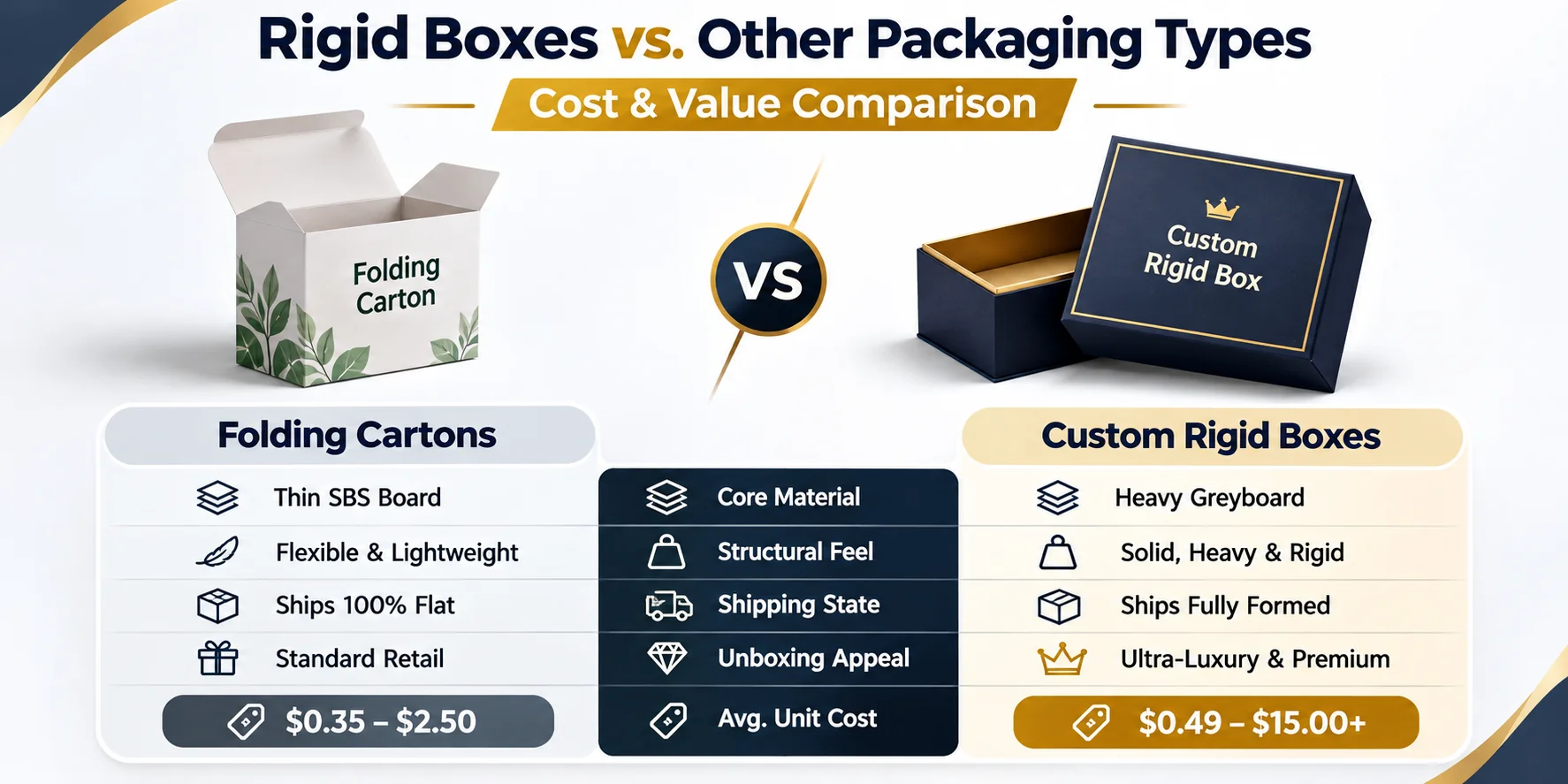
Why do custom rigid boxes cost more than folding paperboard cartons? The key difference lies in the material used and manufacturing process.
Folding Cartons: Made from thin, bendable SBS paperboard (16 pt to 24 pt). They ship completely flat, assemble quickly, and cost around $0.35 to $2.50 per unit. They are ideal for everyday lightweight items.
Custom Rigid Boxes: Built using a thick, unbendable greyboard core (1 mm to 3 mm) wrapped in a premium printed paper. They offer unmatched durability and structural elegance.
| Feature | Folding Paper Cartons | Custom Rigid Boxes |
|---|---|---|
| Core Material | Thin SBS Board | Heavy Greyboard (Chipboard) |
| Structural Feel | Flexible & Lightweight | Solid, Heavy & Rigid |
| Shipping State | Ships 100% Flat | Ships Fully Formed (or Foldable) |
| Unboxing Appeal | Standard Retail | Ultra-Luxury & Premium |
| Avg. Unit Cost | $0.35 – $2.50 | $0.49 – $15.00+ |
What Makes Rigid Boxes More Expensive to Manufacture?
If you are upgrading your packaging from standard boxes to rigid boxes, understanding the manufacturing craft is really important because it explains where your money goes.
1. Two-Part Structural Construction
Every rigid box consists of two main layers:
-
Structural Greyboard Skeleton: Heavy chipboard panels that are die-cut and grooved to form the walls.
-
Outer Decorative Wrap: High-grade art paper, textured linen stock, kraft paper, or specialty metallic wrap that is printed and glued seamlessly over the dense skeleton.
2. Specialized Wrapping & Assembly Time
Rigid boxes retain their solid shape, they cannot simply be glued on a single automated high-speed folder. Wrapping edges neatly, securing internal corners, lining the interior, and installing magnetic closures or ribbons require a mix of specialized semi-automated machines and detailed manual craftsmanship.
The 7 Primary Cost Drivers of Custom Rigid Box Manufacturing
When engineering luxury rigid packaging, pricing is calculated based on exact structural specifications. At The Rigid Boxes, every custom quote is determined by different core cost drivers. Knowing how these factors influence production expenses allows you to maximize cost efficiency without giving up premium appeal.
1: Order Quantity & Machine Setup Amortization
Order volume is the single most powerful factor determining your cost per unit. Producing custom boxes requires high initial press setup, configuring automated gluing guides, mounting steel cutting dies, and setting paper wrapping tension.
-
Low Volume Orders: Fixed tool making and press setup fees are split across a small number of boxes, keeping individual box prices higher ($2.80 to $9.50+ per unit).
-
High Volume Orders: Fixed machine setup fees drop to pennies per box. The steepest per unit price reduction occurs between 500 and 3000 units, where unit costs often drop by 35% to 50%.
2: Structural Styles & Box Architectures
The physical design of your rigid box dictates material yield, machine runtime, and manual assembly requirements. Below is a realistic price comparison across standard rigid box opening styles based on market benchmarks:
| Structural Design | Production Cost Tier | Unit Investment Range (1,000 Units) | Optimal Industry Applications |
|---|---|---|---|
| Lid-and-Base (Two-Piece Set-Up) | Standard / Baseline | $5.00 – $8.00 | Apparel, footwear, electronics, and general premium retail packaging |
| Hinged Book-Style Box | +20% to +35% over baseline | $6.00 – $10.50 | Corporate gift sets, luxury media kits, and promotional PR boxes |
| Collapsible (Foldable) Rigid Box | +15% to +25% over baseline | $5.75 – $10.00 | E-commerce brands seeking high-end unboxing with low storage footprint |
| Magnetic Closure Boxes | +25% to +40% over baseline | $6.50 – $11.00 | High-end skincare, beauty products, and luxury cosmetic kits |
| Slide-Out Drawer (Sleeve & Tray) | +30% to +50% over baseline | $6.50 – $12.00 | Fine jewelry, watches, luxury accessories, and gift card sets |
| Shoulder & Neck Box (3-Piece) | +35% to +50% over baseline | $7.00 – $12.00 | Artisanal spirits, perfumes, candles, and luxury glass containers |
3: Exterior Dimensions & Surface Footprint
Physical dimensions directly scale your raw material consumption. Increasing height, length, or width requires larger greyboard sheets, wider paper wrap rolls, and more adhesive.
-
Small Rigid Boxes (3" × 3" × 2"): Material usage is low, but delicate manual edge wrapping keeps base unit costs around $2.00 - $5.00 on small runs.
-
Medium Rigid Boxes (8" × 6" × 3"): The sweet spot for small automated wrapping machinery ranges from $1.20 to $3.00.
-
Larger Rigid Boxes (14" × 10" × 5"): Require double-sized chipboard sheets and extensive hand finishing, pushing unit costs to $4.00 - $10.00+.
4: Chipboard Core Thickness (Greyboard Density)
The structural inner core of every rigid box is made of heavy greyboard measured in millimeters (mm) or points (pt).
-
1.5 mm Greyboard (approx. 60 pt): Standard lightweight core. Suitable for small gift sets, playing cards, and lightweight cosmetics.
-
2.0 mm Greyboard (approx. 80 pt): Industry standard choice for sturdy retail packaging, footwear, and consumer devices.
-
2.5mm – 3.0mm Greyboard (100 pt – 120 pt): heavy duty construction engineered for wine bottles, puzzle boards, or oversized presentation kits.
Depending on the thickness, this greyboard generally ranges from 800 GSM to 2000 GSM in paper weight, providing the necessary density and structural durability for each packaging tier.
5: Outer Wrap Materials & Paper Stock Selection
The paper wrapped around the greyboard skeleton defines the box’s outer appearance and tactile feel.
-
C1S/C2S Art Paper (128 gsm–157 gsm): Coated paper ideal for sharp, full color offset CMYK printing. This is the most cost-effective choice.
-
Unbleached Kraft Paper (Brown, White, and Black): Delivers a clean, eco-friendly aesthetic.
-
Specialty Textured & Fabric Wraps: Linen stocks, pearlescent paper, metallic foils, or velvet add $0.15 to $0.50+ per box in raw material cost.
6: Post-Press Finishes & Embellishments
Speciality surface treatments protect printed artwork and create contrast on retail display shelves.
| Finishing Option | Unit Cost Range | Aesthetic & Protective Benefit |
|---|---|---|
| Matte / Gloss Lamination | $0.05 – $0.20 | Standard protective film against scuffs, dust, and moisture |
| Soft-Touch Lamination | $0.10 – $0.35 | Delivers a velvety, smooth texture with scratch resistance |
| Spot UV Varnish | $0.08 – $0.30 | Applies glossy sheen over specific graphic areas or logos |
| Hot Foil Stamping | $0.10 – $0.45 | Applies metallic foil (gold, silver, or rose gold) under heat |
| Embossing / Debossing | $0.10 – $0.40 | Creates raised or recessed 3D details on brand logo |
7: Custom Inserts & Internal Cushioning
An inner tray holds your items securely in place while creating an organized unboxing presentation.
-
Folded Paperboard / Cardstock Inserts
-
High Density EVA/Foam Inserts
-
Thermoformed Velvet-Flocked Vacuum-Formed Trays
Does Printing Increase Rigid Box Cost?
Yes, the printing method and coverage can affect the final quote. One packaging pricing guide gives an estimated 0.20 - 0.60 per unit additional cost for digital printing. Digital printing can be useful for shorter runs because it does not require traditional printing plates.
The best printing method therefore depends on the quantity, artwork, color requirements, and packaging specifications.
Secondary Costs & Budgeting Fees to Account For
When comparing custom rigid box quotes across different manufacturers, evaluating only the base unit price can create an incomplete financial picture. A quote that seems cheap initially can quickly grow once secondary tooling, pre-production sampling, and freight shipping fees are calculated into your final landed cost per unit.
To create a realistic packaging budget, your procurement team must factor in every step required to transform a digital structural dieline into a finished, delivered rigid box.
Custom Die-Cutting and Stamping Tooling Fees
Because custom rigid boxes are made to your product's specific dimensions, physical tooling must be manufactured prior to mass production:
- Steel Rule Cutting Dies: Dies designed to cut heavy greyboard panels and paper wraps accurately. Cutting die fees typically range from $100 to $350 depending on overall box size.
Pro Tip: Most professional manufacturers (including The Rigid Boxes) store your physical custom dies in-house and waive tooling fees on future reorders that use the same dimensions.
Pre-Production Physical Samples & Proofing
Skipping physical sampling before approving a bulk production run is risky. Physical prototypes allow you to test item fit, verify hinge smooth movement, test magnet strength, and review color accuracy under real-world lighting.
-
Unprinted Structural Prototypes: Samples cut on CAD plotting tables to verify box dimensions and insert fits typically range from $30 to $70.
-
Fully Printed Pre-Production Samples: Production grade samples matching your exact run specifications (offset printing, lamination, custom foil, inserts) generally cost $100 to $250 due to dedicated machine setup time.
-
Sample Credit Policies: Standard physical sample kits that carry an initial processing fee of $19.99 to $50.00 are typically credited back toward your invoice total once your full production order is confirmed.
Freight, Shipping, and Volume Logistics
Unlike folding paperboard cartons that ship 100% flat on packed pallets, fully assembled custom rigid boxes ship, taking up their full physical shape. Because of this volume, freight shipping represents a noticeable portion of your total landed budget.
-
Ocean Freight Shipping (High Volume / Lower Cost): Best for production runs over 1,000 units when your project schedule allows 25 to 40 days for transit. Ocean freight typically adds 10% to 20% to your overall per-box landed cost.
-
Air Express Freight Shipping (Fast Delivery / Higher Cost): Essential for tight product launch deadlines (3 to 7 days transit time). Air carriers calculate fees based on volumetric (dimensional) weight, which can add 30% to 60%+ to base box unit prices.
-
Collapsible Rigid Box Advantage: Selecting collapsible rigid boxes that ship flat and assemble instantly via self-adhesive corner tabs can cut shipping volume and warehouse storage space needs by up to 70%.
6 Proven Strategies to Reduce Custom Rigid Box Costs
Lowering your packaging expenditure does not mean giving up the luxury unboxing presentation your customers expect. By applying smart structural adjustments and strategic sourcing choices, you can trim per-unit costs while keeping a high-end feel.
Strategy 1: Scale Order Quantities to Hit Volume Price Breaks
Press setup fees are fixed. Increasing an order from 500 to 1000 or 2500 units dramatically drops per unit costs. Sourcing a 6- to 12-month supply upfront yields maximum ROI.
Strategy 2: Replace Foam Inserts with Die-Cut Cardstock
Custom EVA foam inserts are $0.50 - $2.50+ per unit. Switching to precision cut paperboard inserts cuts costs to $0.15 - $0.50 per unit while making your box 100% recyclable.
Strategy 3: Standardize Outer Dimensions Across Product Lines
Don't build unique box sizes for every product variation. Order one master box size in bulk to unlock quantity discounts, then differentiate SKUs using low-cost custom sleeves ($0.10 – $0.30/unit), stickers, or modular inner trays.
Strategy 4: Choose Direct Box Architectures
Intricate gatefold or multi tier shoulder boxes require intensive hand assembly. Switching to a classic two piece lid and base or standard drawer styles cuts manufacturing costs by 15% to 35%.
Strategy 5: Focus on One Hero Finish
Try to choose only one primary accent like a crisp foil logo on a matte wrap for a cleaner look at a lower cost.
Strategy 6: Trim Wasted Internal Headspace
Trimming even half an inch off length, width, or depth reduces greyboard material consumption, outer wrap size, master shipping carton volume, and freight delivery charges.
Industry Sector Pricing Benchmarks & Real-World Examples
To accurately project your packaging budget, analyze how custom rigid box pricing plays out across specific retail industries. Different product categories prioritize distinct structural setups, protective inserts, and surface finishes.
| Industry Sector | Preferred Box Architecture | Core Specifications & Finishes | Target Order Run | Average Unit Cost |
|---|---|---|---|---|
| Cosmetics & Skincare | Magnetic closure or two-piece shoulder | 2.0 mm greyboard, soft-touch matte, gold foil logo, die-cut foam tray | 2,500 – 5,000 units | $1.45 – $2.60 |
| Jewelry & Watches | Compact two-piece or hinged book-style | 2.5mm core, linen/suede wrap, debossed emblem, velvet-flocked tray | 500 – 1,000 units | $2.80 – $5.50 |
| Consumer Electronics | Precision lid-and-base (air-release vacuum) | 2.0mm high-density chipboard, C1S art paper, spot UV, EVA foam insert | 3,000 – 10,000 units | $1.10 – $2.15 |
| Apparel & PR Kits | Large drawer box or collapsible magnetic | 2.5 mm–3.0 m heavy greyboard, full-color print, satin ribbon, tissue lining | 250 – 1,000 units | $3.80 – $9.50+ |
Deep Dive: Minimum Order Quantities (MOQ) Explained
Understanding Minimum Order Quantities (MOQ) is essential when planning your packaging timeline. First time buyers are often surprised to find that custom rigid box manufacturers impose strict minimums compared to suppliers of standard folding cartons.
Why Do Rigid Box Manufacturers Have MOQs?
Unlike standard boxes that can be run on fully automated high speed presses in a matter of minutes, producing custom rigid boxes involves significant manual setup and structural calibration.
-
Machinery Calibration Time
-
Material Sheet Minimums
-
Custom Tooling Fabrication
-
Labor Allocation
Custom Rigid Box Production Timelines: From Dieline to Delivery
Planning your luxury packaging timeline is just as critical as managing your production budget. Because custom rigid boxes require multi-layer assembly, thick chipboard cutting, and specialty wrapping, manufacturing lead times are longer than standard single-layer folding cartons.
Standard vs. Expedited Rush Timeline Breakdown
| Project Stage | Standard Timeline | Expedited Rush Timeline |
|---|---|---|
| Design & Artwork Dieline Prep | 2 to 5 business days | 1 to 2 business days |
| Digital Proofing & Customer Approval | 1 to 3 business days | Same day to 1 business day |
| Structural or Printed Sampling | 3 to 7 business days | 2 to 4 business days |
| Bulk Production (After Proof Approval) | 8 to 10 business days | 5 to 7 business days |
| Shipping & Final Delivery | 3 to 10 business days | 1 to 3 business days (Air Express) |
Note: Expedited rush production is not available for every box architecture or specialty wrap. Rush scheduling may limit your physical sampling window, so always confirm whether a supplier's quoted turnaround time covers production completion or doorstep delivery.
Key Factors That Impact Rigid Box Lead Times
Several factors can add extra days to your packaging turnaround time. Some of them are given below:
-
Structural box complexity
-
Multi step specialty finishes
-
Order quantity & batch size
-
Specialty material availability
-
Supplier peak capacity
How Rush Orders Work & What to Expect
Requesting rush production makes sense when your product launch is tied to a fixed trade show date, influencer PR push, or unexpected inventory sell-out. However, expedited orders come with specific trade-offs:
-
Higher Cost: Rushing an order requires suppliers to rearrange press schedules, run overtime shifts, or use air express freight instead of standard ocean transport.
-
Design Adjustments: To meet an urgent deadline, you may need to simplify your box structure or select standard in-stock wrapping papers over custom-milled specialty papers.
-
Shorter Testing Windows: Rushed production leaves less time for multiple physical sample rounds, making accurate digital dieline proofing critical before greenlighting the run.
Partner With The Rigid Boxes For Your Next Project
Navigating custom packaging pricing doesn't have to be overwhelming. At The Rigid Boxes, we specialize in engineering bespoke, high-end packaging solutions tailored precisely to your budget, branding vision, and product specifications.
Whether you need a sleek magnetic presentation box for skincare products, a classic two-piece box for electronics, or a space-saving collapsible box for luxury apparel, our team provides transparent pricing, zero hidden fees, free structural dielines, and expert guidance from design concept to final delivery.
Ready to elevate your unboxing experience? Contact The Rigid Boxes today to request your custom quote and order your pre-production sample kit!
Frequently Asked Questions
Are custom rigid boxes eco-friendly and recyclable?
Yes! The core chipboard skeleton is manufactured from 100% recycled paperboard and post-consumer waste.
What is the starting cost of rigid boxes?
The starting cost of rigid boxes may be $0.49 each at volume and according to specifications. This is just the starting price and does not mean that it is the standard price for rigid boxes.
Is it worth it for small businesses to use custom packaging?
Yes, MOQ flexibility helps small businesses try custom boxes to improve product protection and branding opportunities.
What factors affect the price of luxury rigid boxes?
The price of rigid boxes will vary depending on construction and finishing options, but not on the name luxury. A magnetic closure, tray, or fitted inserts will make it more expensive than a simple lid and base box.
How much of my product's retail price should I spend on rigid packaging?
For most luxury and e-commerce brands, total packaging expenses typically account for 3% to 8% of the product's retail price (or cost of goods sold).
How long does rigid box production take?
Production is typically listed at 8–10 business days after proof approval, plus delivery. And for rush delivery, it will take 4 to 6 business days.
Final Thoughts
Rigid boxes are more than just protective packaging, they are a physical extension of your brand's perceived value. While the upfront cost is higher than standard folding boxes, the return on investment comes through stronger shelf presence, reduced product damage, and a memorable unboxing experience that turns first-time buyers into repeat advocates.
By understanding how order volume, structural style, core thickness, and specialty finishes shape your quote, you can make deliberate trade-offs that protect your margins without sacrificing luxury appeal. Whether you are testing the market with a small batch of 250 units or a larger volume of up to 10,000 boxes, starting with clear structural goals and factoring in secondary costs like tooling and freight will keep your packaging budget predictable from dieline to doorstep.